
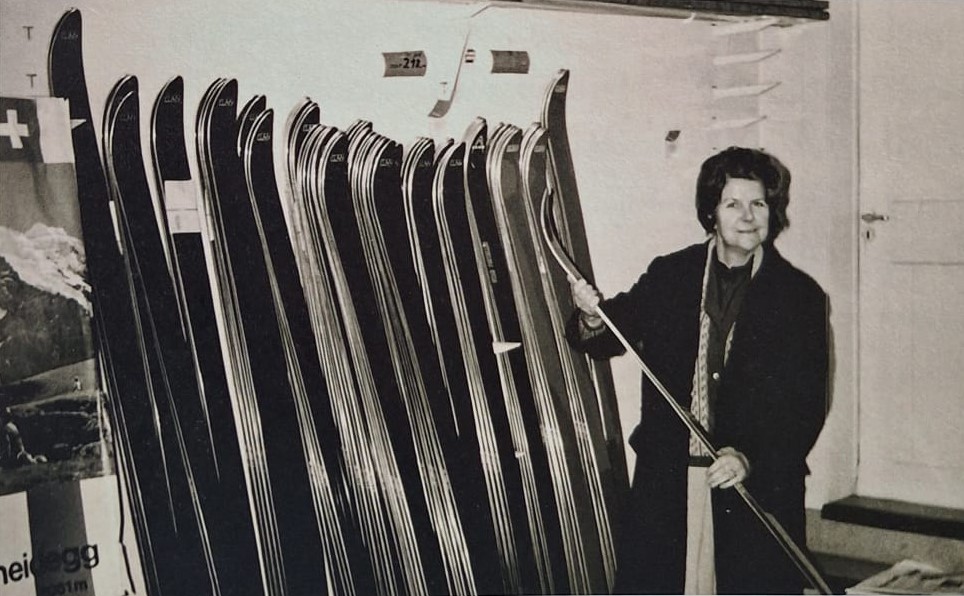
His mother Rosemarie in the discount ski shop in Lucerne, 1971.
To understand Mobimo, you need to understand Alfred Meili. Or at least try to. Of course the real estate company is no longer the same business that the Lucerne native co-founded more than two decades ago; it has evolved. But he is still in it, in its DNA: the man who sells skis as a student and buys his first plot of land with the profits.
Noted down neatly on a sheet of A4 paper are the anecdotes that Alfred “Fredy” Meili will recount about Mobimo’s early years. How he claimed prior to the public offering that he didn’t speak English – to annoy the UBS bankers who had sprinkled their presentation with Anglicisms. Or how he persuaded the City of Zurich with his persistent visits to let him place the company signage on Mobimo-Hochhaus. “Just for two years,” he asked, “to support the IPO.” The name has been written there ever since.
“Do good, earn money, enjoy life,” is how Meili explains his credo. Later he says, “My story shows that it is possible to work your way up from any social class.”

Alfred Meili at nine years old, 1956.
You just have to know the market. And have ideas.
Meili has plenty of those. He is tireless, works seven days a week. His flashes of creative inspiration won’t let him rest. Or other people, either. “At the weekend, when the Grasshoppers had a home game, we could calculate it exactly: end of the match plus driving time to Zollikon – and then the first emails started arriving, even on Saturday evening or Sunday afternoon,” Paul Schnetzer, late former CEO of Mobimo, remembers. “He was the driving force behind the company.”
Fate has a twist in store for everyone – the son of a Lucerne native who had worked his way up to own a hairdressing salon finds this out when he can barely walk. In 1948, when Fredy is only just one year old, his parents divorce. His mother takes a position as a restaurant manager in a hotel and has to send her little boy to live with distant relatives in French-speaking Switzerland. When she finally brings him home, the two of them move into a little flat in Säntihof in Lucerne, which becomes too cramped for mother and son after a time. Spatially, but also emotionally. “I am sure,” Alfred Meili writes in his biography, “that these cramped conditions were the source of my later ambition to invest in real estate”.

The founders of Mobimo: Alfred Meili (left) and Karl Reichmuth.
“DO GOOD,
EARN MONEY,
ENJOY LIFE.”
Fredy realises early on that he “could have a better life if I earned money”. His father lets him manage an old cigarette vending machine, and that’s how he earns his own pocket money. At 15, Alfred Meili begins buying second-hand bikes from a local bicycle dealer and reselling them through the classifieds. At 18, the school pupil opens a shop where he sells discontinued lines of well-known ski brands. He calls the business “Skicount”. It does well, very well. On Saturdays there are often people queuing in front of the outlet.
Alfred Meili puts the profit from the ski business into his first property. He freshens up the wooden benches in the stairwell of the four-apartment building with red paint himself, and his school friend and later Mobimo Board member, Kurt Bättig, helps him to lay floor coverings made of Chinese pig bristle.
Meili studies economics in St. Gallen, law in Zurich, earns his doctorate and works successfully as a commercial lawyer. But at 50 he is looking for a change. “I started under the illusion that the job of a real estate agent was much easier than a lawyer’s, so you don’t need to work as hard,” Meili said once. But in fact his passion for properties still has a hold on him, even during his time as a lawyer. He reads in the paper where building work is currently under way. In his free time, he drives from building site to building site, asks questions. Learns by listening.
Then, in October 1997, when the real estate crisis is slowly coming to a close but prices are still low, Meili, together with Lucerne private banker Karl Reichmuth, founds Mobimo, “mobile Immobilien” (German for “mobile real estate”).
Reichmuth, the son of a master cheese-maker from the Canton of Schwyz, had got his private bank off the ground one year earlier. “I noticed that several of our larger clients had invested far too little in the real estate category when constructing their portfolios,” he says. That is about to change.
“WE WERE UNITED BY A COMMON PURPOSE. BUT MOST OF ALL WE WERE FRIENDS.”
Meili and Reichmuth know each other professionally; both were involved in the development of retailer Pick Pay. They get on well. “I said to Fredy, ‘You may be a good lawyer, but you are an even better real estate buyer.’ He really had a very special gift for recognising the potential of a property,” the banker recounts. Without each other, they could not have made Mobimo work. “Yes, we were united by a common purpose. But most of all we were friends.”
For Reichmuth, it’s quite clear: the business has to be a limited company; a property fund is out of the question for him. The investor’s investments need to remain liquid, which is why he intends to float Mobimo on the stock exchange in the near future. Reichmuth got his way with “the obstinacy of the Central Swiss,” he says. Mobimo starts off with share capital of CHF 36 million, provided by Reichmuth’s clients. This is the strategy: 70% investment properties that yield secure returns, 30% development projects in the residential property sector, where there is real money to be made.
The founding of Mobimo was “brave”, says Georg Horka, one of the first employees of the young company. “Hardly anyone wanted to invest in property at that time. In Seefeld in Zurich, houses in a good location were for sale at a price that you couldn’t even get half an apartment for now. And no one dared to buy them.”
Other brave turns are taken by the new company, which was incorporated into Mobimo Holding in 1999. While others are still hesitating, the company opts for geothermal probe heating, the Minergie standard and energy- saving façade solutions. Art on buildings is a passion from the beginning. And, of course, architecture. Competitions are held to ensure the quality of the projects – the aim is to create buildings that are aesthetically pleasing. Or as Alfred Meili put it, “not to keep blighting the landscape with hideous vanilla slices.”
And that brings us to point number one in the Meili credo: Do good. For that, you need to be successful. “The profits also give us the opportunity to be socially responsible and considerate, be it to our employees or tenants or third parties. You can’t act like a capitalist from 8 to 5, and only think about social issues in the evenings,” he says.
The early days are wild. In true start-up fashion, the company dares to do things differently. Routes for decision-making are short, the tasks are many and varied. And in the midst of it all Alfred Meili, Chair of the Board, CEO and shareholder in one. “Sometimes, he came into the office and said to us that he had just bought two plots of land,” says Horka. Meili could “negotiate like the devil”, according to journalist Karl Lüond. “If he is shown the door, he comes back in through the window, or through the chimney if need be.”
The entire Board of Directors meets once a month and discusses ideas and projects. And the debate can get heated. “It was anything but a boardroom full of nodding heads,” recalls Urs Ledermann, who was elected to the Board of Directors in 2001. Meili and Reichmuth could “argue tremendously”. “That friction created energy.”

The end of the founding era: Karl Reichmuth retires at the Mobimo general meeting in 2009. On the podium (from left to right): Members of the Board of Directors Wilhelm Hansen, Brian Fischer, Peter Schaub, Paul Schnetzer, Karl Reichmuth, Georges Theiler, CFO Manuel Iten, Chair of the Board of Directors Urs Ledermann and CEO Christoph Caviezel.
Mobimo grows. From three to 20, to 40 employees. First, it makes a name for itself in real estate circles and then, with the purchase of the former Sulzer office tower on Escher-Wyss-Platz, in the public sphere. “A name is made”, the Handelszeitung writes in March 2001.
On Thursday, 23 June 2005, the day finally dawns that Mobimo founder Karl Reichmuth had planned from the beginning: the public offering. And it shows great promise. The issue is oversubscribed sixfold. On the first day of trading, the share closes at CHF 187.50, nine per cent over the issue price. “For stock exchange newcomer Mobimo, it is primarily the high direct returns that are drawing the conservative investors out of the woodwork. In some cases, the real estate shares investors currently hold are being sold in order to get fully on board with Mobimo,” is the analysis by Cash. Time to celebrate: the party follows three weeks later with 100 guests. The dress code, the invitation says, is “Kravatte” (German for tie).
The real estate portfolio grows. By the end of 2006, it is already worth more than one billion Swiss francs. The buildings have names like “Frohe Aussicht” (pleasant view), “West- Art”, Novavida,” “Hexagon”. But Mobimo keeps on emphasising that the aim is to be better, not bigger.
The company is well positioned, records hefty profits, and the strategy stands. And as the months pass, Alfred Meili decides, “The business doesn’t need me any more.” On 8 May 2008, the man who writes in his autobiography, “there is nothing more lasting than land” hands over his mandate as Chairman of the Board of Directors of Mobimo Holding and is elected Honorary Chairman.
One year later the founding era finally comes to an end: Karl Reichmuth resigns from the Mobimo Board of Directors. When asked today how it feels that some “no-name from Lucerne”, as one article put it, which was founded by two friends, has now become the fourth-largest real estate company in Switzerland, he answers with a Chinese proverb: “If the root stands firm, the branches grow.” Reichmuth reveals: “I think part of the secret to Mobimo’s success is that it is run like a family business.” A true elective affinity.


