
Überall hends bauet, Tower um Tower, um Tower, um Tower” (“They’ve built everywhere, tower after tower after tower”) a voice sings in Zurich dialect to a melodic reggae beat. “Und ich wür so gern no chli bliibe doch kein Stei bliibt meh de glich” (“And I’d love to stay a while, but not one stone has stayed the same”). This farewell to Zurich West was written by musician Dodo in 2018. Ruefully, he laments the evolution of the former industrial district, which is changing and no longer offers him a home. “Und vilicht erchänni di irgendwänn nüme” (“And perhaps some day I won’t even know you”).
Opinions about Zurich West, the area between Gleisfeld and Limmat that’s 2’000 metres long and 700 metres wide, are sharply divided. While the Frankfurter Allgemeine Zeitung reports enthusiastically that “the sedate banking stronghold is suddenly displaying an exciting metropolitan face,” the NZZ feels that the district is “extremely staid and dead”. It’s a fact that no other district in Zurich is so controversial, so hard to understand, so ambivalent.
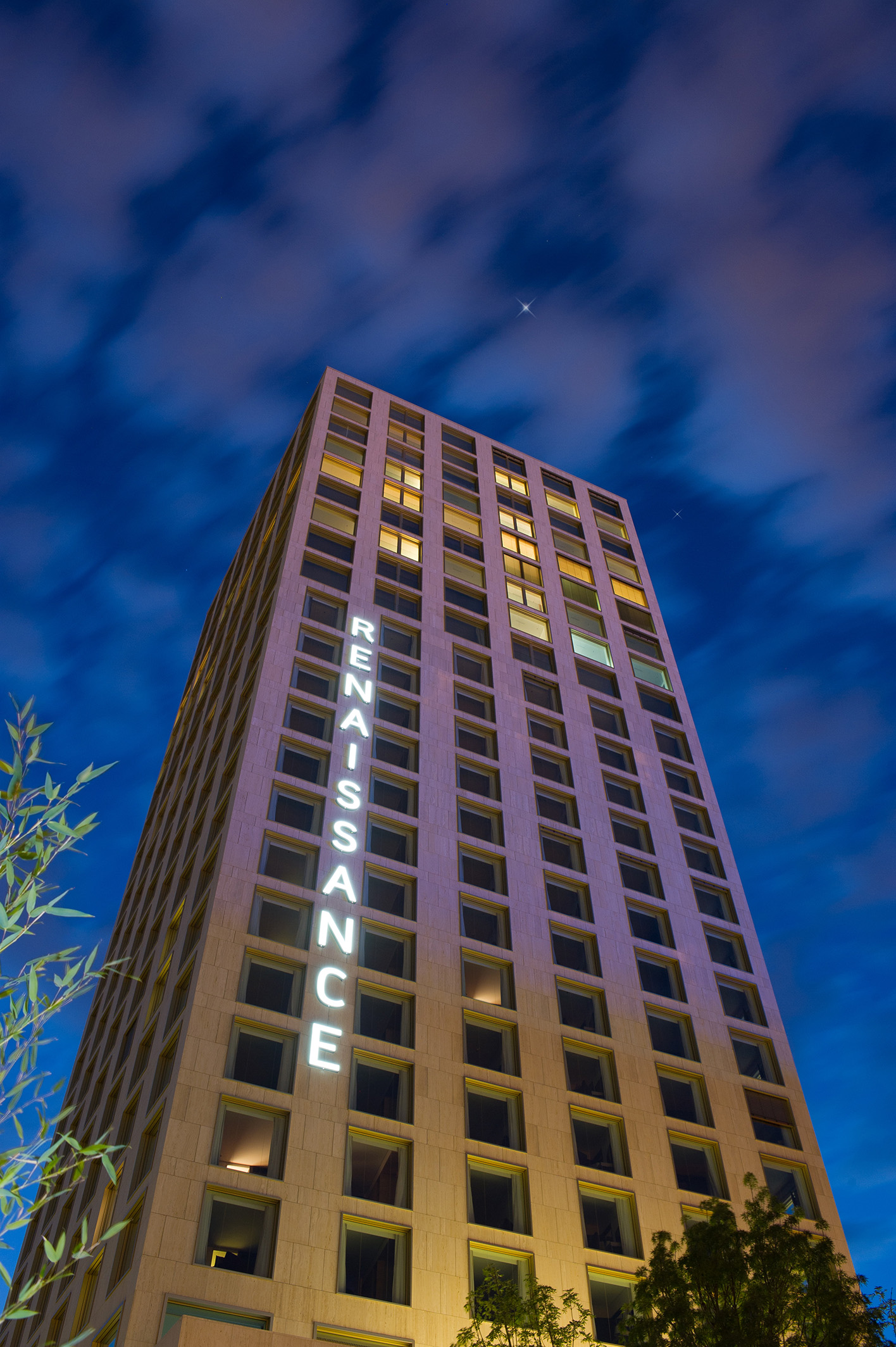
But its history also shows that in Zurich West, renaissance is more than just the name of a hotel. So it would seem logical, almost fated, that one of Mobimo’s most ambitious projects was carried out in this part of the city – heralding if not a rebirth, then certainly a new epoch for the real estate company.
“Any Märklin fan would love the view,” says Stefan Buchs, and points from a panoramic window on the 15th floor. Below him are tracks with trains running, as tiny as a model railway landscape. The cheerful Buchs, who hails from Baden Württemberg in Germany, is the General Manager of the 5-star hotel Renaissance Zurich Tower. He has also lived in Dubai, London and Prague. No, not all the guests who stay in one of the 300 rooms immediately understand the charm of Zurich West, he says. “It doesn’t have much in common with the Switzerland shown in picture books.” But he personally loves the fact that it’s “proper city” here.
“THEY’VE BUILT EVERYWHERE, TOWER AFTER TOWER AFTER TOWER.”
The tower that General Manager Buchs loves working in is 81 metres tall, with a bar and fine dining restaurant on the ground floor and 53 privately owned apartments on the nine floors above the hotel. It was designed by Basel architecture firm Diener & Diener for Mobimo.
The proposal was described by Finanz & Wirtschaft in August 2008 as “the most ambitious project in the company’s barely ten-year history”. In its annual report for the same year, Mobimo wrote that with a total investment of approximately CHF 250 million, including CHF 37 million for the site, Mobimo Tower was the biggest project to date.
The area around Turbinenstrasse 20 had already had a somewhat chequered past. The first time that the street, then still on the outer limits of the city, made its way into the headlines was on 10 April 1906. “Last Monday, at around two in the afternoon, a conflagration started in the industrial district, just behind the large engineering works of Escher, Wyß & Co. In front of a stable attached to the two-storey Pfingstweid residence, at Turbinenstrasse 20, was a pile of straw, probably put there to dry. Two small boys were playing there with matches, lighting a ‘little fire’. To their delight, the straw suddenly went up in flames,” reported local newspaper Neue Zürcher Nachrichten.

Mobimo Tower and “am Pfingstweidpark” Complex, 2019
Eight cows and all residents of the building were rescued unharmed. “A great crowd of spectators gathered around the burnt-out building all afternoon, of which now only the bare walls are standing.”
A few months later the Zürcherische Freitagszeitung commented: “In this district, still in its infancy,” it seems that the “worthy councillor” must have left the naming of the streets to the Board of Directors of neighbouring company Escher Wyss. Because, the paper said, the biggest attraction that Turbinenstrasse has to offer is “two muck wagons”.
The management of engineering firm Escher Wyss had indeed decided in 1889 to build a new manufacturing plant in Hard. Turbines, ships, paper machines, steam locomotives: all were built in the enormous factory buildings. Other business were already in the neighbourhood or followed suit: the firm of Steinfels, for example, that made soap out of old fat, brewery Actienbrauerei Zürich and Maag Zahnräder AG.
Now there was industry in the industrial district. But the rise was followed by the fall. With the structural changes in the economy at the start of the 1980s, companies moved away or closed their doors for good. Three-quarters of the jobs in industry disappeared. The production sites deteriorated and gradually became neglected wasteland. The district suffered. Where 2248 men, women and children had lived in the district in 1930, the figure was down to 1513 by 1990.
Eventually, the government recognised the problem – and also the potential that the development of the industrial brownfield land offered. No, the city wasn’t built yet. Here was an opportunity for a bold step, for “Zurich’s belated, but all the more brash, attempt at frenetic city living,” commented FAZ.
In 1996, the city council seized the initiative and convened the Stadtforum: Social Democrat mayor Josef Estermann set about finding workable compromises between the city and landowners, and between sustainability and profitability, for the vacant industrial site.
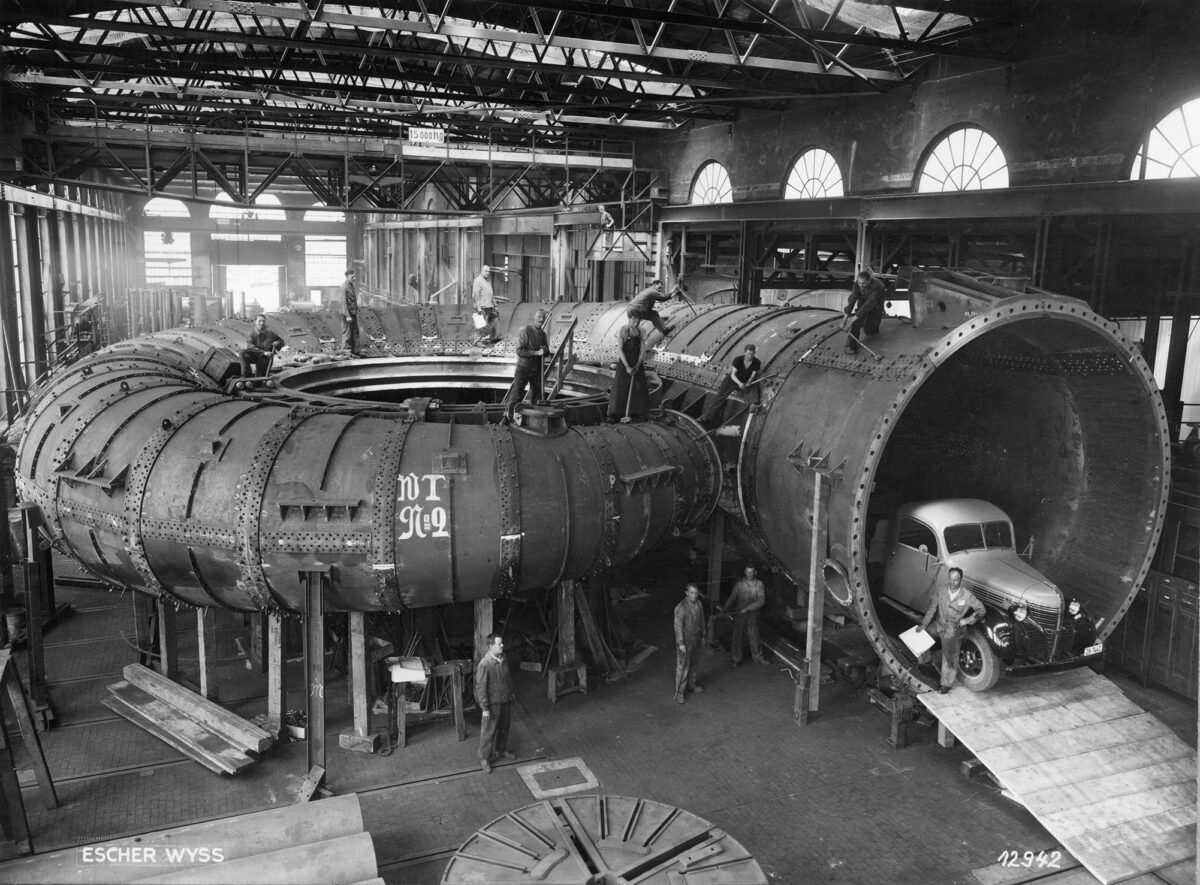
The Escher Wyss engineering plant also produced gigantic turbines in Zurich’s industrial district. Shown here: assembly of a volute casing, 1939.
A new start followed, and so did change. Puls 5 opened its doors, followed by the Prime Tower on the Maag site and the restored arches of the railway viaduct. And amongst them the clubs, restaurants and workshops that sprang up through temporary use. A Zurich West scene of dreamers, nuts, students, lawyers, artists and bankers had emerged. Soon it was known as the district to be in.
And this was where Mobimo wanted to build its tower. It wasn’t the first project in the district. Mobimo-Hochhaus, an office building constructed to Minergie low energy standards, has stood in the vicinity of Escher-Wyss-Platz since 2001.
Works on Turbinenstrasse began in May 2009. Not without detractors. The Young Socialists criticised the “overpriced luxury apartments no one needs”.
In 2010, when half the Mobimo Tower had been built, project manager Marc Pointet declared in business magazine Bilanz, “We’re not selling a high-rise at all, we’re selling something much more attractive: views and life in a five-star hotel, encased in Roman travertine.” There was an aspiration for vertical neighbourhoods, Pointet said, where people don’t just live, but can also take care of many other things.
“WE ARE NOT SELLING A HIGH-RISE AT ALL.”
Mobimo had already had to rethink one aspect, however. Although they had secured a tenant with a 25-year lease in the form of the Renaissance hotel chain, the planned privately owned high-end apartments proved hard to sell. The response was to make the living spaces smaller – and the prices. The penthouse on the 24th floor, for example, designed with 1180 square metres of floor space, now became four apartments.
When criticism of the striking high-rise and the development of the district in general didn’t abate, Marc Pointet countered in the Magazin of the Tages- Anzeiger: “I don’t understand the concerns that the tower could be a symbol of the gap between rich and poor, and that a few millionaires are living here totally separated from the local residents of Kreis 5,” he said in July 2011, a few weeks before the building opened. “Our clients are successful entrepreneurs or top managers – ordinary people.”
Nevertheless, a feng shui consultant was brought in for the tower. “You feel this positive, weighty energy in the tower,” said project manager Pointet.
Pleasing as the energy was, the luxury apartment experience also signified a change of course for Mobimo. “We will not continue in this sector,” said Christoph Caviezel, who had taken over the position of CEO in 2008, at the presentation of the financial results in 2012. In future, Mobimo would concentrate on the middle segment. Condominiums in that price range still sold like hotcakes, Caviezel said.
“Du häsch kei Platz meh für mich” (“You don’t have room for me any more”), Dodo sings in his song about Zurich West. “Ich akzeptiers. (I accept that.) Drum nimi Abschied vo dir. (So I’ll say goodbye to you.) Obwohl i di lieb. (Although I love you.)”
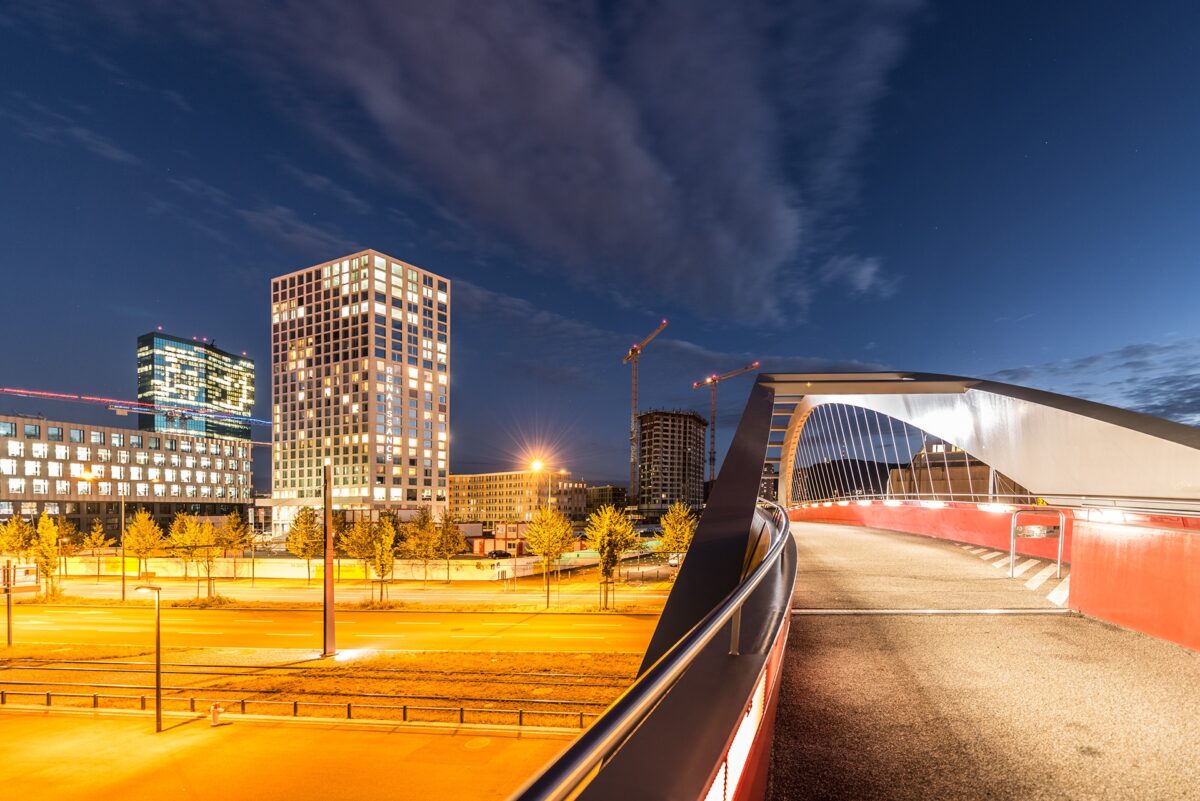
Lights on: The Zurich West Skyline, 2013


